It’s mid-February, in what’s called the “dead” of winter. However, life is very much alive. Much of it is just in rest mode. Black Bears (Ursus americanus), Striped Skunks (Mephitis mephitis) and Raccoons (Procyon lotor) are napping. Fish in lakes and ponds have slowed down and spend a lot of time at the bottom. Also at the pond bottom are Green Frogs (Lithobates clamitans) and Bullfrogs (Lithobates catesbeianus). Even though they have lungs, they don’t need to surface because they absorb oxygen from the water through their skin. Trees have gathered most of their sap to the roots but soon will be sending it back up to the branches. Insects such as adult Bird Grasshoppers (Schistocerca emarginata) usually die after the first frost, but not before females lay eggs that overwinter.
However, it’s the insects that overwinter as larvae or adults that have always fascinated me in how they survive the winter. This winter rest in insects is called diapause. Last spring, I saw what looked to be a large, black, “wooly bear” caterpillar on steroids crawling quite fast for its size across my patio. I took a photo of it and used my iNaturalist (link) app to identify it. It was a Giant Leopard Moth (Hypercompe scribonia) larva. It had spent the entire winter as a larva.

The Giant Leopard Moth is a cousin to the more well-known Wooly Bear caterpillar, also called the Isabella Tiger Moth (Pyrrhartia isabella). Both are members of the tiger moth family, the subfamily Arctiinae in the family Erebidae. The Giant Leopard Moth is the largest of the tiger moths in the US. They are found from southern Canada south to Florida and west to Minnesota and Texas.
As I write, the temperatures are falling into the teens and there is a glaze of ice on already compacted snow. How are these insects surviving such harsh conditions as caterpillars? For one thing, they seek out shelter under logs and in leaf litter. A neat trick they use is producing glycerol in their circulatory fluid – an antifreeze! While in the death-like state of diapause, the glycerol prevents their cells from freezing. The bristly “hairs,” called setae, probably don’t keep them warm, but make it harder for predators to eat them. When the larva is curled up in a defensive position, red bands are exposed. This is aposematic, a warning coloration to predators that they taste bad.

The caterpillar I saw last spring had overwintered and was probably crawling to find a place to change or pupate into a cocoon or pupa. Giant Leopard Moths stay as a pupa for a few weeks before metamorphosing into an adult moth with bright white wings covered with black spots. The centers of the spots can be white, black, or an iridescent blue.
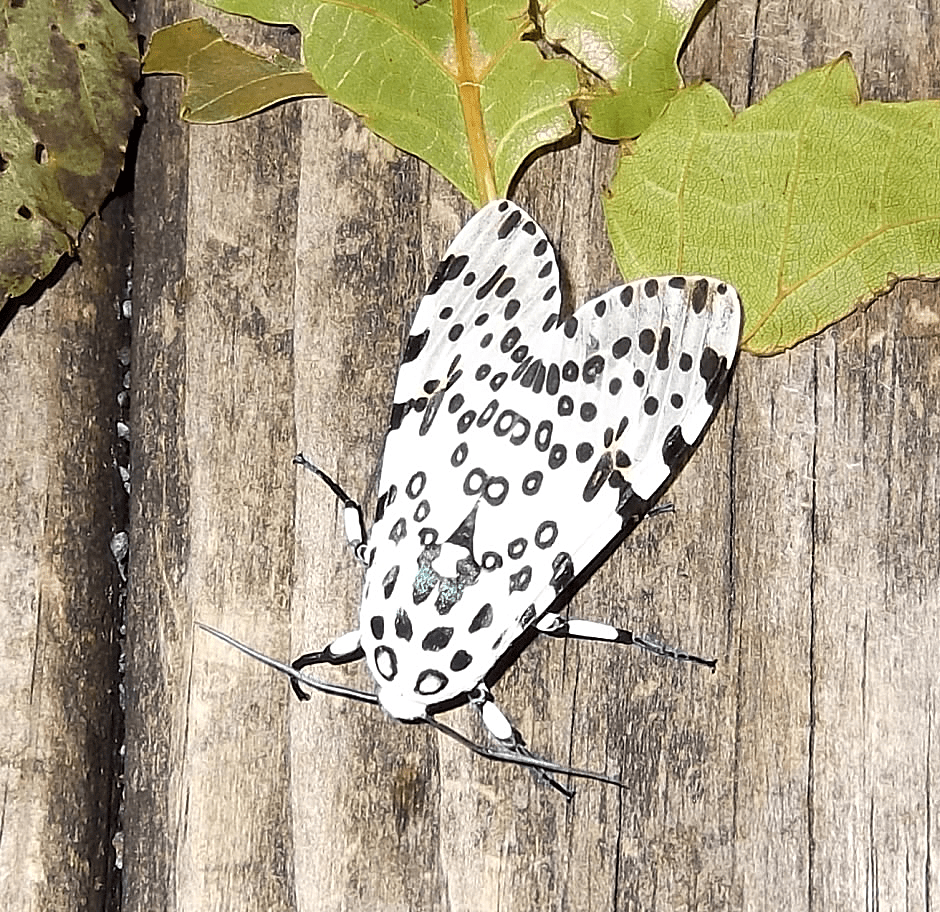
Adult males are about 2 inches long and have approximately a 3.5-inch wingspan. Females are smaller – about 1.5 inches long with a little over a 2-inch wingspan. Adults live for only a few days, just long enough to find a mate. Like many moths, the female produces pheromones from a gland at the tip of her abdomen. These pheromones are carried on the wind and are detected by the male’s antennae, allowing him to follow the scent to his prospective mate. After mating and eggs hatch, larvae feed on a variety of plants, including sunflowers (Helianthus sp.), Pokeweed (Phytolacca americana), Plantains (Plantago sp.), Cherry (Prunus sp.), Black Locust (Robinia pseudoacacia), Willow (Salix sp.), and Violet (Viola sp.).
Giant leopard moths are not commonly seen throughout their range. In my yard, I leave the leaves in garden beds and at the edges of my property. I don’t spray with pesticides and herbicides and I maintain a wide variety of species of plants. I’ve left logs lying on the ground for animals to hide in and under. My messy yard likely won’t make the cover of Fine Gardening magazine. But that seems to suit Giant Leopard Moths just fine.
 Beyond Your Back Door
Just lovely to read your thoughts on winter and what is going on that we do not see. I discovered a praying mantis egg case the other day (surprise!) and thought Spring is not too far away. Just as it always is.
LikeLike
Hi JimLoved learning all about the Leopard moth overwintering! Glad you’re back
LikeLike
A breath of cool fresh air to read your blog!
LikeLike
Thank you! Glad to have you back
LikeLike