My wife has a keen eye for the little things. We were walking on our local bike path the other day and she spied a beetle on the pavement. She is always helping critters cross the greenway. Turns out this beetle wasn’t so little. At up to an inch and three-quarters (4.5 centimeters) long, this Eastern Eyed Click Beetle (Alaus oculatus) is one of the larger beetles in Connecticut. Also called Eyed Elater, it is a member of the Elateridae, the click beetle family.
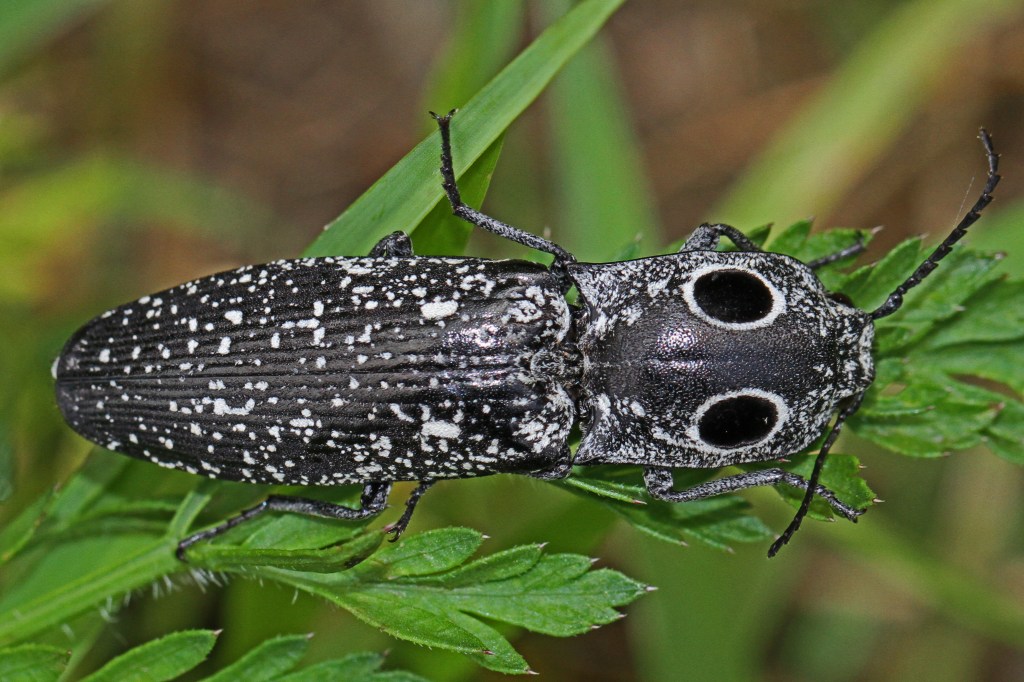
What a neat-looking insect! It has two large “eyes” on its pronotum (a plate on the upper surface of the thorax), markings that evolved to startle or confuse potential predators.
The adult Eastern Eyed Click Beetle has a long, thin body. Along with its large fake eyes and black-and-white, mottled coloring, you can identify it by its behavior. This beetle often “plays dead” when picked up. Try turning a click beetle onto its back (please return it to where you found it afterward). By quickly snapping a spine-like structure into a groove on the underside of its thorax, it will flip suddenly as much as 6 inches (about 15 centimeters) into the air. It usually lands right-side up. This can startle a predator and also help the beetle escape. The snap is accompanied by an audible click that gives the beetle its name.

Eastern Eyed Click Beetle larvae are 2.5 inches (6.35 centimeters) long, wormlike, shiny, and segmented. Called wireworms, they have six small legs and are brownish and darker brown near the head. They look a bit like the mealworms sold at bait and pet shops, but have large mandibles.
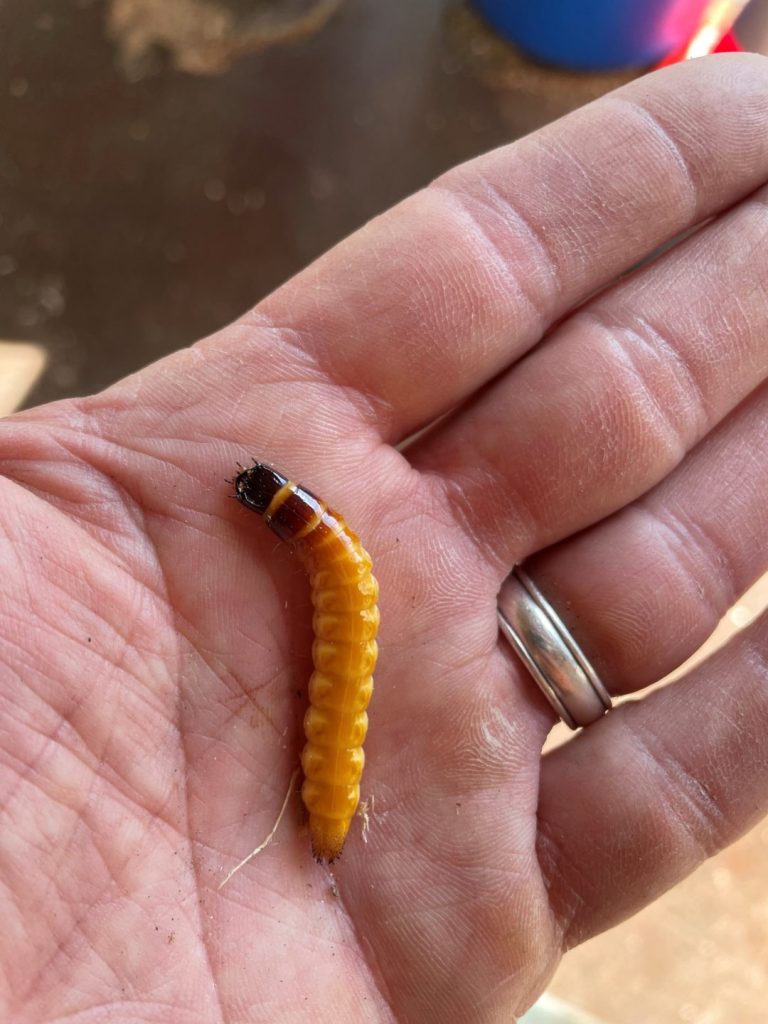
Many click beetle larvae are herbivores and agricultural pests that damage wheat, corn, and potato seedlings. The larva of the Eastern Eyed Click Beetle, however, is a voracious predator. It lives in decaying wood and feeds on the larvae of flies, moths, and especially on those of the insect family Cerambycidae, the longhorn beetles. In one study, click Eastern Eyed Click Beetle larvae were observed to eat over 200 cerambycid larvae each (see Insect Enemies of Eastern Forests by F.C. Craighead).
The Eastern Eyed Click Beetle spends two to five years as a larva, but live for only a few weeks as an adult. Adults don’t eat much, but have been seen feeding on nectar and plant juices. These beetles are found in hardwood forests that have lots of rotting logs, especially cherry, apple, and oak.
A fascinating, uncommon insect, the Eastern Eyed Click Beetle is worth keeping an eye out for. Enjoy them whenever you are lucky enough to see one.
 Beyond Your Back Door
Excellent!
LikeLike
Thanks honey!
LikeLike
My granddaughter found an Eye Click Beetle on my carport today. It was the first that I’ve ever seen! Nobody knew what it was, so thank you for the information! We live in Cottondale, Alabama.
LikeLike
That’s great JoAnn. an amazing insect, eh?
Best, Jim
LikeLike
Thanks, Jim and Willow, for your detailed commentary.
LikeLike
Thanks Nan!
LikeLike
Very interesting. I’m not sure if i’ve ever seen one.
LikeLike
Hi Rick, yes very interesting and you know it when you see it!
Best, Jim
LikeLike
Very interesting; I’d never heard of this before. Keep these posts coming!
LikeLike
Never seen a large click beetle but have made a few small ones click! I found your article quite through, I will certainly keep an eye out for the larger bug.
LikeLike
I don’t believe I ever saw one, but I will keep my eyes open for these “eyes”.
LikeLike
I love Click Beetles. And I love that I learned so much about them I didn’t know from your post here. Their larvae being wireworms was a huge surprise. The wireworms in the vegetable garden were hated enemies. I’m so glad those garden wire worms aren’t the same ones as found in wooded areas. Years ago I found a Big-Eyed Click Beetle on the Red Oak next to my dwelling. So cool!
LikeLike
Six of these Beatles showed up on a hot afternoon when I was painting some wood sort of one after another they appeared they crawled around on the wood and crawled on my hat and then onto my glasses and after about 15 minutes, they flew away one by one. Thanks for helping me discover more about them. I may paint a portrait of one of them to remember them by.
LikeLike
Hi Les, You must have just seen a hatch. That’s really neat! All best, Jim
LikeLike
I have just now spotted one at my home in Ticonderoga, NY. I’ve never seen such a thing, lol!! Neat but, creepy looking. I wish I could upload my picture..
LikeLike
Kasey, that’s great! Glad you found one. All best, Jim
LikeLike
NE PA. First time ever seeing – had two of them today
LikeLike
That’s great Kelli! All best, Jim
LikeLike
encountered one today 6/1/2024 on my front door screen, very interesting! Loved just typing in a description and magically the right picture comes up!
LikeLike
So glad you found one Tom!
All best,
Jim
LikeLike
I found an Eastern Eye Click Beetle on the side of my home, just days before Hurricane Beryl hit Houston, TX, (July 2024). I wonder if it sensed it should move to higher ground.
I took a slow motion video, quite the acrobat, I counted 5 revolutions.
LikeLike
Hi Margaret, that makes you wonder, doesn’t it? Glad you found one! All best, Jim
LikeLike
My son and I came across one of these amazing insects in our yard today in Huntersville, North Carolina 7/22/24. First time ever seeing one!
LikeLike
Hi David, so sorry for the delayed response. I needed to change my email and it took a while! So happy you were able to see one! All best, Jim
LikeLike
I fish for catfish at Glen Rose Texas on the Brazos River every year for about 44 years.I found the shell of this big eye Eastern click beetle.Brought it home to Mansfield,Tx for my great granddaughter.17 yr old,Zephyr.thanks for letting us know what it is.
LikeLike
Hi Janie, sorry for the really long delay in replying! I retired recently and lots of changes. Thank you for writing and replying to my post. All best, Jim
LikeLike